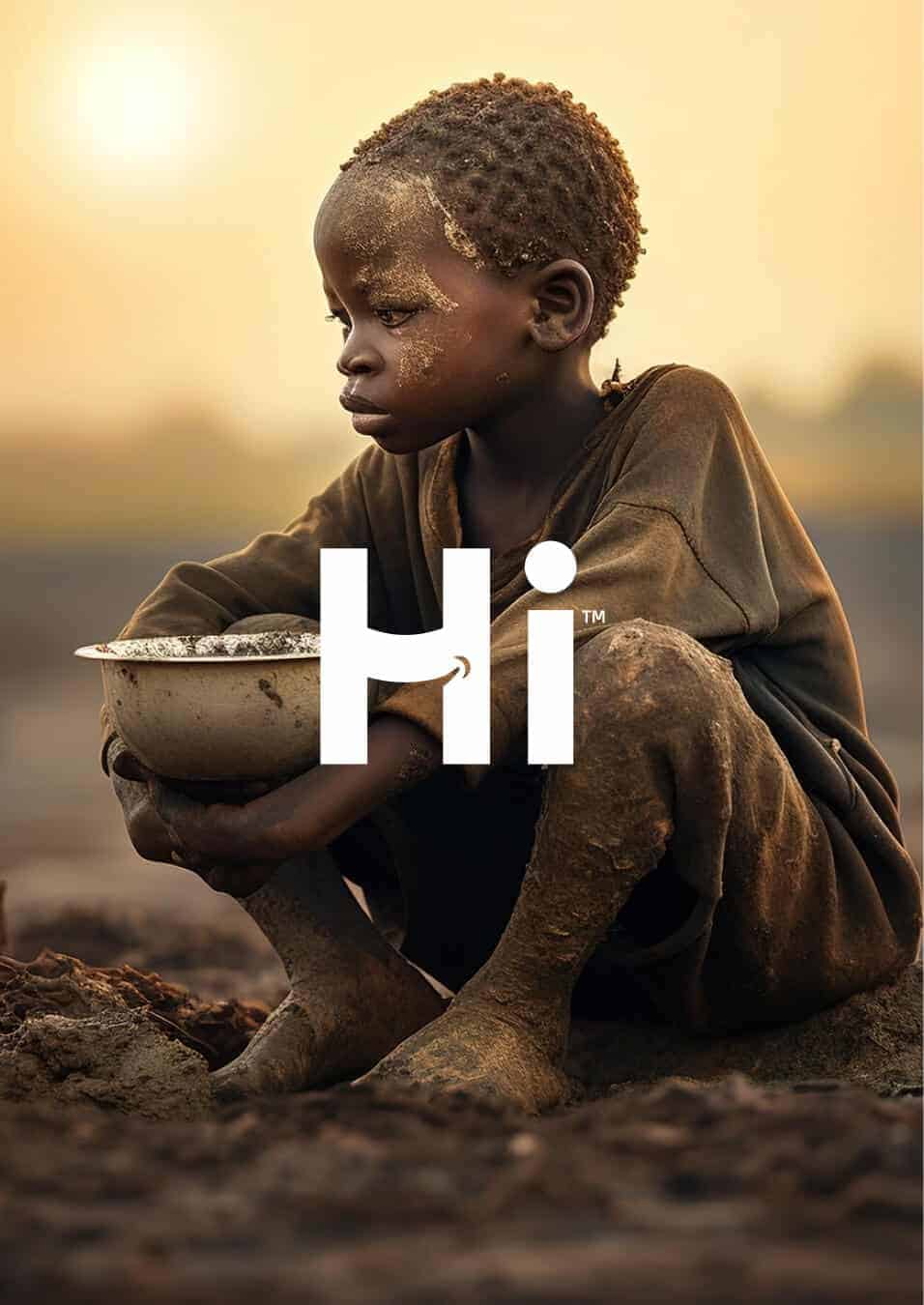
Your Zakat can transform lives
Zakat is more than an obligation. It is a sacred trust that uplifts communities, restores dignity, and brings hope to those facing hardship
100% Zakat Policy
Your donation goes directly to people in need. No fees are deducted.
What Is Zakat
Zakat, meaning “to purify,” reminds us that all wealth belongs to Allah. As a fundamental pillar of Islam, it is a powerful act of charity that requires every eligible Muslim to give 2.5 percent of their annual wealth to support those in need.
Rooted in compassion and justice, Zakat uplifts communities and restores dignity to the most vulnerable.
Why Zakat Matters Today
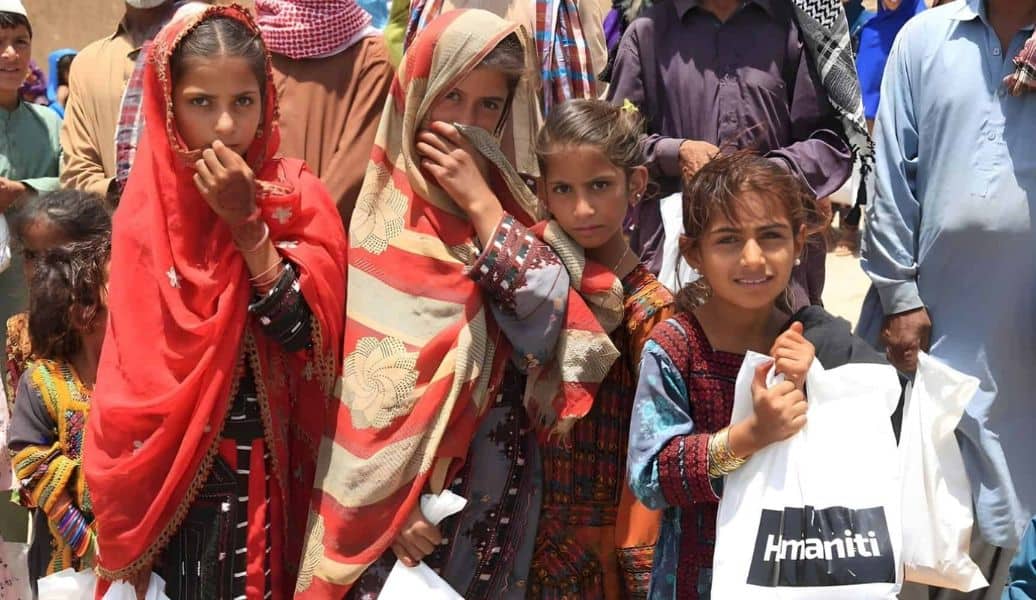
Today, more than seven hundred million people around the world live in extreme poverty. Many face food insecurity, lack of clean water, displacement, illness, and financial hardship.
Conflict, climate disasters, inflation, and the lingering effects of the pandemic have pushed even more families into crisis.
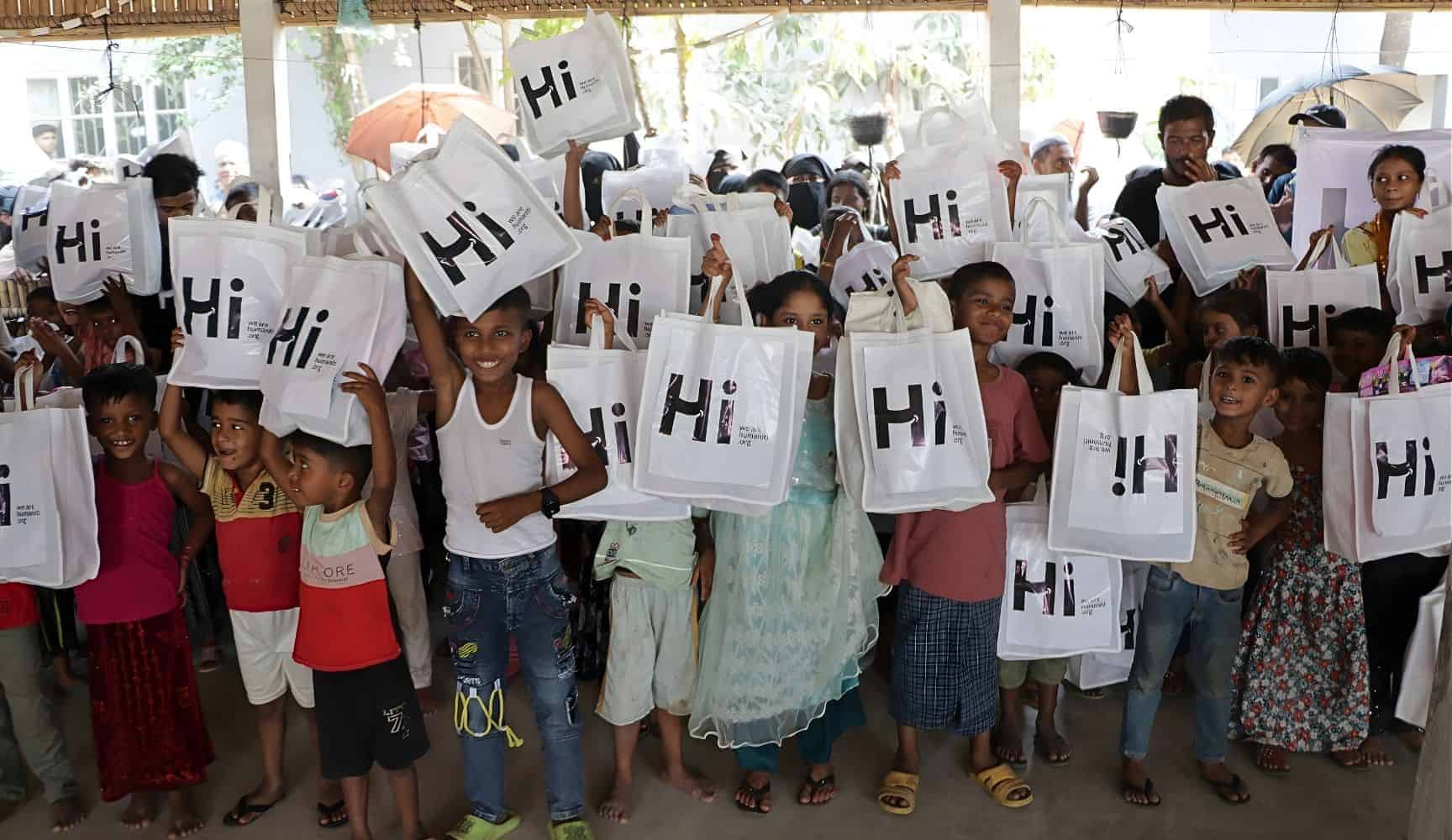
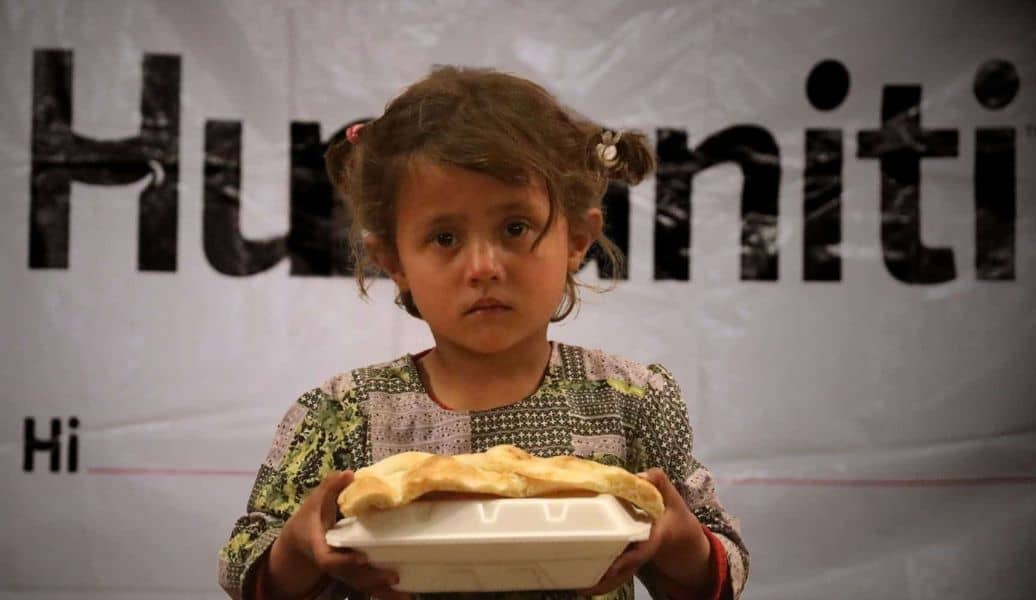
By giving your Zakat, you provide essential relief to those struggling with poverty, hunger, displacement, and illness. Zakat directly supports orphans, widows, refugees, and families in crisis, ensuring they receive the care they deserve.
How Humaniti Uses Your Zakat
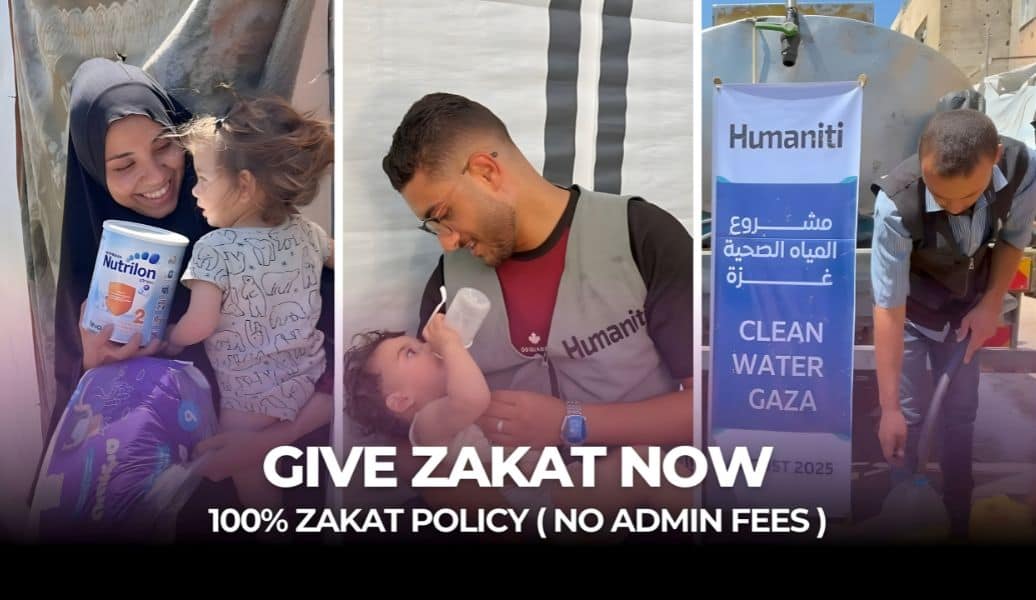
At Humaniti, we ensure your Zakat reaches those who need it most. Your contribution helps fund life-saving programs around the world, including:
- Food security for families facing hunger
- Health care support and medical aid
- Education initiatives for children and youth
- Emergency relief for people affected by crises and disasters
In a world filled with hardship, your Zakat becomes hope in action.
Scholarly Endorsement
Humaniti’s Zakat Policy is endorsed by Mufti Yūsuf Badāt, the respected main Imam at the Islamic Foundation of Toronto. He serves as a director and instructor at Mathabah Institute and is the President of Imam Services Inc.
Mufti Yūsuf Badāt is committed to serving humanity and uplifting those in need. His guidance ensures that Humaniti’s Zakat distribution aligns with Islamic principles and fulfills the trust placed by donors.
Maximum efficiency, maximum transparency
Your donations fund our solutions and the lives they change. But don’t take it from us. Trust the organizations that fund our programs and attest to the impact they witness year after year.


FAQ about Zakat
The nisab is the minimum amount of wealth that a Muslim must possess before zakat becomes obligatory. It is currently equivalent to approximately 85 grams of gold or 595 grams of silver.
The rate of zakat is 2.5% of one’s total wealth, including savings, investments, and business assets.
The purpose of zakat is to help those in need, promote social justice, and purify one’s wealth. It is also considered a religious duty and a means of seeking Allah’s blessings and avoiding punishment.
Zakāh expenditures are only for the poor and for the needy and for those employed for it1 and for bringing hearts together [for Islām] and for freeing captives [or slaves] and for those in debt and for the cause of Allāh and for the [stranded] traveler – an obligation [imposed] by Allāh. And Allāh is Knowing and Wise. (Quran 2:110)
100% of your Zakat goes directly towards our Zakat eligible programs and initiatives.rnrnu0026nbsp;
Zakat must be paid by every sane, adult Muslim, who owns wealth over a certain amount – known as nisab – they must pay 2.5% of that wealth as zakat.
Zakat is reserved for individuals or groups who fall into one or more of eight categories designated by God in the Quran, chapter 9, verse 6.rnrnIndeed, [prescribed] charitable offerings are only [to be given] to the poor and the indigent, and to those who work on [administering] it, and to those whose hearts are to be reconciled, and to [free] those in bondage, and to the debt-ridden, and for the cause of God, and to the wayfarer. [This is] an obligation from God. And God is all-knowing, all-wise.rnrnAccording to this, Zakat eligible recipients are:rnu003colu003ern tu003cliu003eThe poor (al-fuqarâ’), meaning low-income or indigent.u003c/liu003ern tu003cliu003eThe needy (al-masâkîn), meaning someone who is in difficulty.u003c/liu003ern tu003cliu003eZakat administrators.u003c/liu003ern tu003cliu003eThose whose hearts are to be reconciled, meaning new Muslims, friends of the Muslim community, and those who can be positively impacted by muslim generosity.u003c/liu003ern tu003cliu003eThose in bondage (slaves and captives).u003c/liu003ern tu003cliu003eThe debt-ridden.u003c/liu003ern tu003cliu003eIn the cause of God.u003c/liu003ern tu003cliu003eThe wayfarer, meaning those who are stranded or traveling with few resources.u003c/liu003ernu003c/olu003e
Yes! Humaniti accepts Zakat donations. The Quran makes it possible for Muslims to pay their zakat to trusted institutions that distribute it to those who belong to one or more of the zakat-worthy categories.rnrnAt Humaniti, we track Zakat donations separately from all other funds, and only use them for Zakat eligible projects.rnrnHumaniti ensures that 100% of your Zakat is given to Zakat eligible recipients across these program areas:rnu003culu003ern tu003cliu003eFoodu003c/liu003ern tu003cliu003eWateru003c/liu003ern tu003cliu003eShelteru003c/liu003ern tu003cliu003eHealu003c/liu003ernu003c/ulu003e
Humaniti follows a 100% Zakat policy which is approved by the following scholar (our Zakat advisor):rnrnMufti Yūsuf Badāt of the Islamic Foundation of Toronto. Many Muslims around the world have entrusted Humaniti with their Zakat and we ensure that every penny reaches those in need.
Zakat Al Maal is the annual charity paid on 2.5% of your net wealth if you are an adult Muslim with the minimum Nisab.rnrnZakat Al-Fitr is obligated during the month of Ramadan prior to Eid Al-Fitr prayers in the amount of at least approximately $10 US dollars for oneself and one’s dependants.rnrnu0026nbsp;
You are more than welcome to drop us an email at [email protected]. One of our advisors will reply back within 3 business days.
In a world filled with hardship, your
Zakat is hope in action
Si estás buscando casinos nuevos online,
en el mercado actual de México existen diversas plataformas recientes que destacan por su diseño moderno,
variedad de juegos y promociones pensadas para nuevos usuarios.
Estos casinos suelen ofrecer tragamonedas de última generación, ruleta, blackjack, baccarat
y juegos con crupieres en vivo, además de métodos de pago adaptados al mercado mexicano
y compatibilidad con dispositivos móviles.
Antes de registrarte, es importante revisar la licencia del operador, las condiciones de los bonos,
los tiempos de retiro y la reputación general del sitio para tomar una decisión informada.
Recuerda siempre jugar de forma responsable, estableciendo límites de tiempo y presupuesto
para mantener una experiencia segura.